Addressing Nearly 65 Representatives of Donor Countries, International Organizations, and International Partners at Second Ministerial Meeting of Palestine Donor Group:
Mustafa: No reform agenda or strategy can succeed without the necessary political and economic conditions for implementation.
Calls on the European Union and regional and international partners to provide immediate emergency budget support to enable the Government to maintain essential public services, ensure institutional continuity, and continue implementing its reform agenda.
Mustafa: If Israel is no longer willing to uphold the customs union framework established under the Paris Protocol, the international community must support the establishment of an independent Palestinian customs envelop.
Highlights significant progress in the Government's reform and institutional development agenda across four pillars and 53 reform milestones, despite extraordinary political and fiscal constraints.
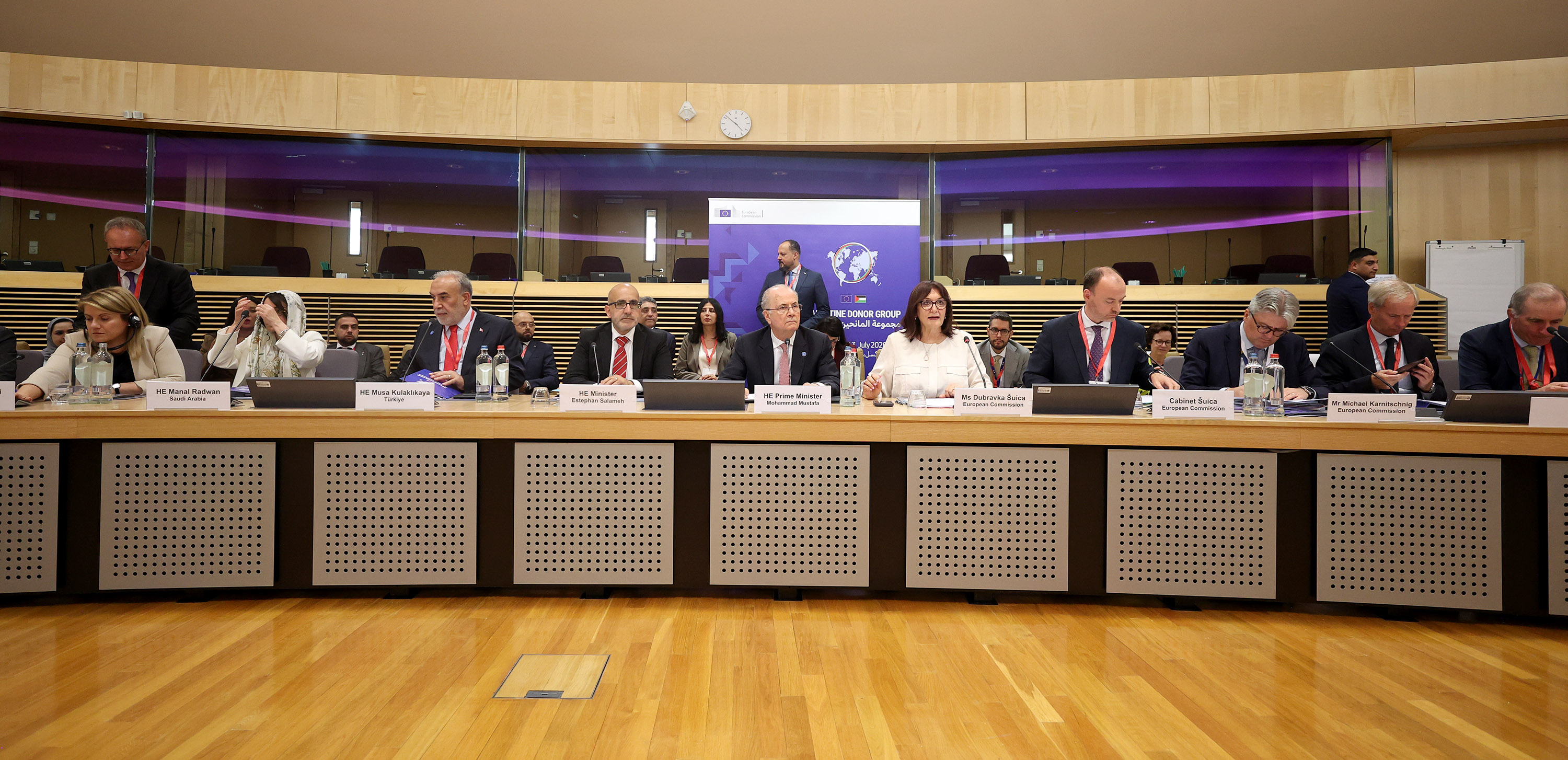
BRUSSELS, July 13, 2026 | Prime Minister’s Office — Prime Minister Dr. Mohammad Mustafa, together with European Commissioner for the Mediterranean Dubravka Šuica, co-chaired the Second Ministerial Meeting of the Palestine Donor Group on Monday at the European Commission headquarters in Brussels. The meeting brought together nearly 65 representatives of donor countries, international organizations, and international partners to discuss support for the Palestinian Government and strengthen assistance for early recovery and reconstruction efforts in the Gaza Strip.
In his address, Prime Minister Mustafa said: "The devastating war on Gaza has left unprecedented destruction, immense human suffering, and a set of political, economic, social and security challenges. In the West Bank, including East Jerusalem, annexation, settlement expansion, settler terrorism, restrictions on movement, and ongoing Israeli efforts to undermine the Palestinian Authority, and the viability of the two-State solution continue to escalate."
"Since October 2023, the Palestinian economy has contracted by 30%, unemployment has risen to 50%, leaving more than 500,000 citizens without jobs. The fiscal gap has reached unprecedented levels due to Israel’s continued withholding of our clearance revenues and the restrictions it has imposed on our financial and economic system," he continued.
The Prime Minister further added: "For the past fifteen months, Israel has completely suspended regular transfers of Palestinian clearance revenues, severely constraining the Palestinian Government's fiscal capacity. Yet despite these immense challenges, the Palestinian Government has remained operational, responsible, and committed to reform, stability, and institution-building."
Prime Minister Mustafa explained that the Government has adopted an eighteen-month strategy designed to transition from reform to recovery, resilience, reunification, and state-building, noting that the strategy is built around five mutually reinforcing pillars, namely: Building National Resilience and Empowering vulnerable Communities; Strengthening State institutions, governance, and the rule of law; supporting Gaza recovery, and the gradual restoration of government responsibilities in Gaza; advancing economic self-reliance through investment in productive economic sectors, digital services, food security, and energy security; and advancing Political Action by expanding recognition of the State of Palestine, in partnership with the Global Alliance, and other international partners.
Prime Minister Mustafa stressed that the success of this strategy requires:
First: Stronger political support from all partners for the Palestinian Authority, taking irreversible steps to end the illegal Israeli occupation and expanding the recognition of the State of Palestine.
Second: Transforming the 1997 EU–PLO Interim Association Agreement on Trade and Cooperation into a full association agreement.
Third: Immediate and predictable emergency budget support from the European Union and regional and international partners to enable the Government to maintain essential public services, ensure institutional continuity, and continue implementing its reform agenda.
Fourth: A coordinated international effort to enable the immediate commencement of Gaza’s recovery and reconstruction by providing the necessary funding and ensuring the unhindered entry of humanitarian assistance, commercial goods, and reconstruction materials required.
Fifth: Support for measures that strengthen Palestine's ability to manage its own economy and public finances.
Prime Minister Mustafa emphasized that reform agenda or strategy can succeed without the political and economic conditions necessary for implementation, and that economic recovery cannot be restored while revenues continue to be withheld, and movement and access remain restricted. Nor can the two-State solution, he stressed, be advanced without meaningful political support and a credible pathway toward ending the occupation.
"Israel's repeated departures from its obligations under the Protocol, including the withholding of Palestinian clearance revenues, restrictions on banking relations, continued limitations on the repatriation of shekel banknotes, restrictions on the movement of people and goods, and cancelling the permits of Palestinian workers, have severely undermined the Palestinian economy, eroded its stability, and brought it to the brink of collapse," the Prime Minister further underscored.
He stressed that if the customs union trading model, agreed under Paris Protocol, can no longer be implemented and respected by the Israeli side, the international community should support the establishment of an independent Palestinian customs envelope.
Mustafa further emphasized that if the existing banking and monetary arrangements cease to function effectively, support should be provided for the gradual establishment of a Palestinian currency and for transforming the Palestine Monetary Authority into a fully empowered central bank. He noted that these measures are essential to advancing Palestinian economic recovery, strengthening economic sovereignty and resilience, and laying the foundation for long-term stability.
During the meeting, Prime Minister Mustafa highlighted the significant progress achieved in the Government's reform and institutional development agenda across four pillars and 53 reform milestones, despite extraordinary political and fiscal constraints. Most agreed reform measures have been completed, while the remaining actions are at advanced stages of implementation.
"In public financial management," he said, " we have strengthened fiscal discipline through expenditure controls, improved debt and fiscal risk management, and advanced reforms aimed at reducing net lending and improving budget sustainability. While in social protection, we have undertaken unprecedented transformation of the Palestinian welfare system in decades, through a new unified social protection framework. "This framework," Mustafa explained, that implements Decree Law No. 4 of 2025 now replaces fragmented assistance schemes, employing a single transparent needs-based system with an independent oversight structure, supported by a national digital platform."
The Prime Minister further added: "In education, curriculum modernization has been advanced consistent with UNESCO standards and international best practice. At the same time, we continue implementing the political reform agenda outlined by President Mahmoud Abbas.
In this regards, Prime Minister Mustafa noted that municipal elections have been successfully conducted across Palestine, including in Deir al-Balah in the Gaza Strip, demonstrating our continued commitment to democratic participation despite exceptionally difficult circumstances.
He confirmed that President Abbas has issued, a few days ago a decree calling for national legislative (Parliament) elections throughout Palestine on November 28th of this year.
Prime Minister Mustafa expressed his sincere gratitude to Commissioner Šuica for her leadership and commitment, and to the European Union for its continued partnership with Palestine. He also extended deep gratitude to all partners, donor countries, international organizations, and international financial institutions for your steadfast support to the Palestinian people and the Palestinian Government during one of the most challenging periods in our modern history.
"Your continued political, humanitarian, and financial support reflects more than solidarity with the Palestinian people. It represents a shared commitment to preserving the viability of the two-State solution, strengthening the Palestinian Authority and its institutions, promoting regional stability and achieving a just, lasting, and comprehensive peace… based on international law, relevant United Nations resolutions, and the Arab Peace Initiative," the Prime Minister concluded.
On the sidelines of the PDG meeting, the European Union, together with Spain, Denmark, Cyprus, Ireland, Greece, Portugal, Italy, the Netherlands, France, Switzerland, and Belgium, signed new contribution agreements with Palestinian Minister of Finance and Planning Dr. Estephan Salameh worth €41.7 million. The agreements provide additional financial support through the PEGASE mechanism, complementing assistance pledged since the group's first meeting. This comes in addition to the €310 million allocated by the European Commission through PEGASE for 2026–2027.



.jpg-5b36b903-6fb6-4503-b9e0-49d62aa0f202.jpg)
.jpg-68e1b2d5-e076-47b2-8c98-2faf554dada3.jpg)
