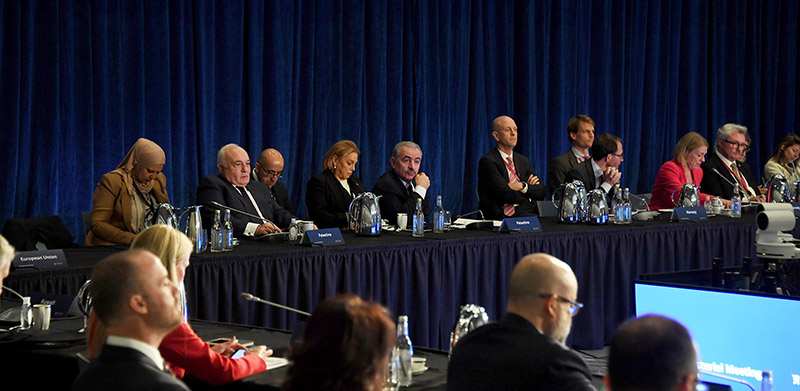
Your Excellency, Minister Anniken Huitfeldt, Minister of Foreign Affairs of Norway, Chair of the AHLC,
Your Excellency, Mr. Josep Borrell, EU High Representative and Vice President,
Excellencies, Ministers of Foreign Affairs and senior government and UN officials,
Excellencies,
Representatives of International Organizations,
I would like to express my gratitude for what you represent. I thank you for what you said, and I thank you for hosting this very important AHLC meeting. As denoted by its name, this Liaison Committee was intended to be Ad Hoc. Unfortunately, Ad Hoc is becoming permanent, just as interim has become permanent.
The outcome of this gathering is very important, and I hope it will enable to us change the status quo together.
I thank you for the efforts that you put into this meeting.
I also extend my gratitude to those who presented the official reports from our partners: the World Bank, the IMF, and the Quartet.
Madam Chair,
I agree with your message that the spirit of Oslo should be maintained. But what is really needed is the respect for the agreements signed here in Oslo.
Having said that, I think the meetings that we had yesterday were very important. The bilateral and technical meetings and presentations made reflected the importance of where we should be going.
We came to this meeting open-minded, and we are ready for action.
The current situation in which we are today in Palestine is extremely difficult because of the political impasse, COVID-19, and the deteriorating reality on the ground.
Madam Chair,
Every single morning, we wake up to the news that there is a new Israeli settlement or that there is new construction to expand the existing Israeli settlements. Today, there are 751,000 Jewish settlers who live illegally in the occupied Palestinian territory.
We are forced to live with 43 checkpoints, arrests of our citizens, a continuing, harsh siege on Gaza, the tragic situation in Jerusalem, particularly in Sheikh Jarrah, and settler terrorism against the very symbol of our culture, with settlers burning olive trees, and uprooting trees, and so on.
This is accompanied with a serious financial crisis that is due to these realities that we have today, as you noted. The status quo on the ground is unsustainable. We cannot continue with this reality. We cannot continue with this status quo. Today, we live in a serious political vacuum, and unfortunately, nobody has the initiative to fill this vacuum.
It is our hope that, as the members of the Quartet are gathered here, the Quartet will come up with a road map that really takes us somewhere. We look to the Quartet to help us to move beyond the status quo to a sustainable situation in which two states are preserved.
The whole world hoped to see a new reality emerge in Israel. It’s a pity that this has not happened. Instead, we listened to the news in which the Prime Minister of Israel said he has three No’s: No to talks to President Abbas; No to negotiations with the Palestinians; and No to two states.
Not one single yes!
We ask Israel to respect the signed agreements.
Madam Chair,
We are very responsible people. We are a responsible government. We take care of our people in Gaza. We spent $1.6 billion every year in Gaza from our resources. Last year, in 2020, we spent around NIS 700 million in Jerusalem, in addition to what we spend in Area 'C’ to preserve the integrity of the Palestinian territory at a time when we collect zero taxes from Gaza, Jerusalem, and Area 'C’. Against all the expenditure needed for those national responsibilities, we can collect taxes only from Area 'A’ and 'B’, which is a limited amount of revenue.
So, with little money, we need to cover so much. Not only for all of Palestine, but also for all Palestinians. We also take care of Palestinians in Syria, Lebanon and other places - at a time when we have no control over our resources and at a time when 62% of our land is under Israeli control. As explicitly stated by the World Bank’s 2014 report, we lose around $4 billion due to the lack of access to the Israeli controlled Area 'C’.
This is a structural problem within which we are forced to exist. It has nothing to do with us. It has everything to do with the reality that we on under occupation.
We must be clear: our crisis today has nothing to do with us implementing the wrong policies or because we are lazy people. The crisis that the Palestinian Authority is in and has been in, for quite some time, has everything to do with the reality in which we live. Additionally, we are bound by unique constraints. When the whole world faced the economic ramifications of the COVID-19, independent states were able to borrow money from the IMF or the international capital markets. Some countries chose to print more of their own currency. However, Palestine does not enjoy these three measures: we don’t have a national currency; we can’t borrow money from the IMF, and we don’t have access to international capital market. This makes the problem much more difficult.
Madam Chair,
What happens on the ground with all these measures is there is a systematic destruction of the two-state solution. What we need to preserve the two states by, firstly, adopt measures that will ensure that Israel stops undermining the two states and, secondly, recognition by the international community of Palestine as a state on the borders of 1967, with Jerusalem as its capital. Otherwise, Madam Chair, if demography numbers are correct, then - for the first time since the establishment of the State of Israel in 1948 – there are 200,000 Palestinians more than Israeli Jews between the river Jordan and the Mediterranean Sea. If we miss the opportunity of two states, this means that we are slipping into a reality of one state in which Israel will be an apartheid state, by de facto and by de jure. I do not believe the Israelis want that. However, this is something that has been explicitly and clearly stated and documented by Human Rights Watch, in its report about Palestine.
When it comes to financial realities, our crisis also has to do with deductions. The Israeli government carries out unaudited deductions. The international aid is declining, corona, and all the responsibilities that we carry in Gaza, Jerusalem, and area C, with no revenues from these areas.
Internally, we were hoping to have elections by May 22, 2021. Unfortunately, Israel vetoed our democracy because Palestinians were not allowed to conduct their elections in the whole of Palestine, including East Jerusalem, contrary to the Oslo agreements signed between Yasser Arafat and Rabin in this very hall. But still, we don’t give up. We are going to have municipal elections, PLO elections, and Fatah elections.
I would also highlight the situation in Gaza, which needs a great deal of care. The issue of and in Gaza is not about economy versus security, as minister Lapid claims. The issue in Gaza has to do with ensuring that there is an integral, comprehensive solution of the Palestinian-Israeli conflict. Because if we handle Gaza alone, then we need to handle Hebron alone, the Jordan Valley alone, or Areas A, B, and C alone. This would lead to a total fragmentation of the Palestinian reality. What is needed is a comprehensive political vision and horizon in which we put things together.
The reconstruction of Gaza is very important. It should not be simply a preparation for another wave of destruction. I was Minister for Public Works and Housing, there are streets and schools that have been constructed 3-4 times, because they are destroyed over and over again.
We need a political horizon to end this cycle of repair and destroy. We need to continue to serve our people under the umbrella and leadership of the Palestinian Authority. But let us be frank and clear: the solution in Gaza is not about changing certain economic measures. The only solution in Gaza is to lift the siege.
Madam Chair,
There are so many things that we should do ourselves. Palestinians have a homework to do. Palestinian institutions are very new. The Palestinian Authority is only 30 years old.
New, institutions often do make some mistakes. If we have made mistakes, we are ready to correct them.
We realize that certain measures have to be taken. Our Minister of Finance is here. He asked the Cabinet to hold a meeting to discuss our expenditures, which we are ready to cut, and our revenues, which we are ready to increase. There are certain institutions that should be merged into ministries. We are also working to reduce medical transfers as well. As well as handle net-lending
But more than that, we are also approving laws and regulations that will create an inducive environment for the Palestinian economy to function in. We passed the Companies Law, Telecommunications Law, E-Government Law, and the Palestine development plan.
Madam Chair,
All what we do will not be enough, Israel has to certain measures that have been taken. Occupation is a source of pain for the Palestinians. We welcome every single step that facilitates the daily life of the Palestinians. But, we need a political horizon, more than small steps taken here and there. We also need action on economic issues that are important to alleviate poverty and employment and improve living conditions for the people.
Jesus Christ was born in Palestine. One important thing that we learned from him is that, one cannot live on bread alone. While we do need improved living conditions, we also need to be a free, independent, sovereign, in state that is contiguous, viable, with Jerusalem as its capital.
How is it possible for our economy to function, if Gaza is so far away and there is no access and movement between Palestinian regions?
How is it possible for our economy to function, if checkpoints prevent the free movement of people and goods promised by the Paris Protocol?
So we need to create an environment within which we can function. This requires not facilitation of the measures taken against us – but the total abandonment of these measures.
These measures include, Madam Chair, the deductions, administrative fees, and other money that should be given back by the Israelis. I believe that it is so important to abandon these measures because money should not be used as a political blackmail when it comes to political disagreements.
I would also like to note that the Israeli government is not accepting its own currency back from Palestinian banks, which means that there is cash accumulated in our banks. And I propose that certain measures should be taken to stop the daily loss caused to our banks because of Israel’s refusal to accept its shekels. The only possible measure is that Palestinian workers who work in Israel should be paid through Palestinian banks - not in cash. This would relieve the excess cash that has been accumulated in Palestinian banks.
For you the international community, our partners in peace and justice, I thank you for all your support, for all what you have done for Palestine, for all what you have done to preserve the two states and to see stability in the Middle East. I hope you continue to stay with us to send a positive message to the Palestinian people, who deserve your attention and assistance. Together, we need to preserve the two states. Even with all the measures that we can be taken by us and Israelis, we still need your assistance to take us out of this bottleneck that we are in today.
Madam Chair,
This hall has hosted Yasser Arafat, Rabin and others who forged an ambitious vision for a prosperous peaceful future for Palestine. We continue to salute the spirit of the Oslo agreement and we continue to commit ourselves to fulfill the obligations from our side. We hope that Israel will fulfill its obligations when it comes to implementing agreements signed between us and them, so that we both will live in peace and justice and in two states - and so that the future generations will salute us and not curse us.
Thank you so much for your hospitality, and thank you so much for enabling such a wonderful gathering to be here, in peace and for peace and justice.




.jpg-5b36b903-6fb6-4503-b9e0-49d62aa0f202.jpg)
.jpg-68e1b2d5-e076-47b2-8c98-2faf554dada3.jpg)
